
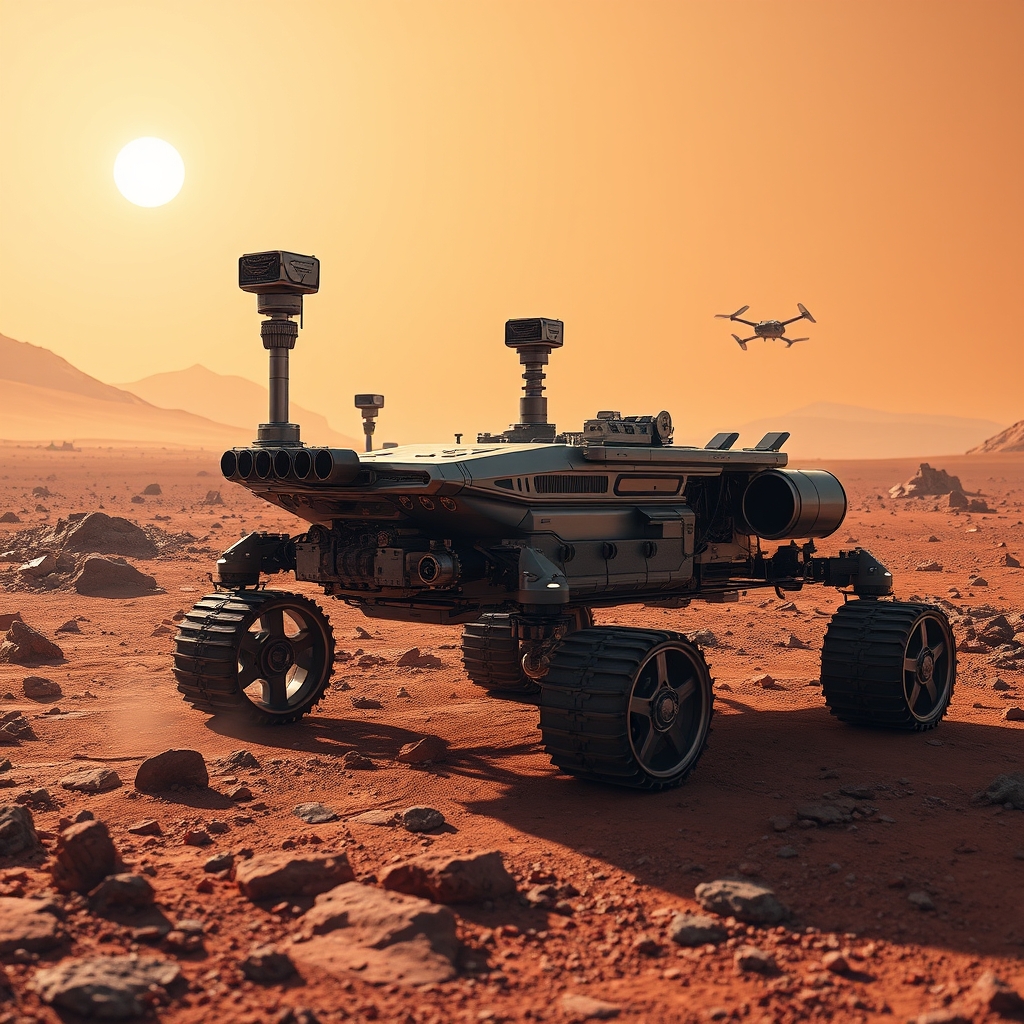
Space exploration has always been a testament to human ingenuity, pushing the boundaries of what we know and where we can go. Yet, as missions grow more ambitious—venturing deeper into the cosmos, targeting distant exoplanets, or even planning crewed missions to Mars—the limitations of traditional methods become apparent. Enter artificial intelligence, a game-changer that is redefining how we explore the final frontier. From autonomous rovers to predictive analytics, AI innovations are not just supporting space exploration; they are making the impossible, possible.
The Rise of Autonomous Exploration
One of the most visible applications of AI in space exploration is the development of autonomous systems. NASA’s Perseverance rover, for instance, relies on AI-powered software to navigate the rugged terrain of Mars with minimal human intervention. The rover’s AutoNav system uses machine learning to analyze images from its cameras, identify obstacles, and plot the safest and most efficient path forward. This autonomy is critical, as the delay in communication between Earth and Mars—ranging from 3 to 22 minutes—makes real-time control impractical. AI bridges this gap, allowing rovers to make split-second decisions that would otherwise require human input.
Beyond rovers, AI is also enabling swarms of small, intelligent satellites to collaborate on complex tasks. Projects like NASA’s Starling mission are testing how groups of CubeSats can work together autonomously, sharing data and adjusting their orbits in real-time to study phenomena like solar storms or asteroid trajectories. These swarms could revolutionize how we monitor space weather, track near-Earth objects, or even assemble structures in orbit without human oversight.
AI as the Cosmic Detective
The sheer volume of data generated by space missions is staggering. Telescopes like the James Webb Space Telescope (JWST) produce terabytes of data daily, capturing everything from the light of distant galaxies to the atmospheric compositions of exoplanets. Analyzing this data manually would be a Herculean task, but AI excels at sifting through vast datasets to uncover patterns and anomalies that might otherwise go unnoticed.
For example, AI algorithms are being trained to identify exoplanets by detecting the faint dimming of a star’s light as a planet passes in front of it—a technique known as the transit method. Machine learning models can distinguish between genuine planetary signals and false positives caused by stellar activity or instrumental noise, significantly speeding up the discovery process. In 2023, AI helped identify a new exoplanet, TOI-2096 b, by analyzing data from NASA’s Transiting Exoplanet Survey Satellite (TESS). This discovery showcased how AI can augment human expertise, allowing astronomers to focus on interpreting results rather than crunching numbers.
AI is also playing a crucial role in the search for extraterrestrial life. Projects like SETI (Search for Extraterrestrial Intelligence) are leveraging AI to analyze radio signals from space, filtering out interference from human-made sources to identify potential technosignatures—evidence of advanced civilizations. By training models on known patterns of natural and artificial signals, AI can flag unusual transmissions for further investigation, bringing us one step closer to answering the age-old question: Are we alone in the universe?
Predictive Analytics and Mission Optimization
Space missions are inherently risky, with countless variables that can jeopardize success—from equipment failures to unpredictable space weather. AI is helping mitigate these risks by providing predictive analytics that can forecast potential issues before they arise. For instance, machine learning models can analyze telemetry data from spacecraft to detect early signs of hardware degradation, allowing mission control to take preventive action before a critical failure occurs.
During the Artemis program, NASA is using AI to optimize mission planning for crewed lunar landings. AI-driven simulations can model countless scenarios, from landing site selection to fuel consumption, ensuring that astronauts have the best possible chance of a safe and successful mission. These simulations also help engineers design spacecraft that are more resilient to the harsh conditions of space, reducing the likelihood of mission-ending failures.
AI is also revolutionizing propulsion systems. Traditional chemical rockets are limited by the amount of fuel they can carry, but AI is helping to develop next-generation propulsion technologies, such as nuclear thermal or electric propulsion. By optimizing fuel efficiency and trajectory planning, AI can reduce travel time to distant destinations like Mars, making crewed missions more feasible and less risky for astronauts.
The Human-AI Partnership in Space
While AI is transforming space exploration, it is not replacing human ingenuity—it is amplifying it. Astronauts aboard the International Space Station (ISS) are already using AI-powered tools to assist with daily tasks, from monitoring life support systems to conducting scientific experiments. For example, the CIMON (Crew Interactive Mobile Companion) is an AI-powered robot that floats alongside astronauts, providing procedural guidance, answering questions, and even offering emotional support during long-duration missions.
Looking ahead, AI will play an even greater role in deep-space missions, where communication delays and isolation pose significant challenges. AI companions could help astronauts manage their mental health, assist with medical diagnostics, or even control robotic assistants that perform maintenance outside the spacecraft. These systems will not only enhance the safety and efficiency of missions but also allow astronauts to focus on the scientific and exploratory aspects of their work.
Challenges and the Road Ahead
Despite its promise, integrating AI into space exploration is not without challenges. The harsh environment of space—with its extreme temperatures, radiation, and vacuum—can disrupt AI systems, requiring robust hardware and fail-safe mechanisms. Additionally, AI models trained on Earth may not perform as expected in the unpredictable conditions of space, necessitating continuous learning and adaptation.
Ethical considerations also come into play, particularly when it comes to autonomous decision-making. For example, if an AI-controlled rover encounters an unexpected situation on Mars, how should it prioritize its actions? Should it preserve itself, complete its scientific objectives, or follow pre-programmed ethical guidelines? These questions are still being debated, but they underscore the need for transparent and accountable AI systems in space exploration.
As we stand on the precipice of a new era in space exploration, AI is proving to be an indispensable ally. It is enabling us to explore farther, faster, and more efficiently than ever before, while also opening up new possibilities for discovery. Whether it’s uncovering the secrets of distant exoplanets, safeguarding astronauts on deep-space missions, or even searching for signs of life beyond Earth, AI is not just a tool—it is a partner in our quest to understand the cosmos. The stars are no longer the limit; they are just the beginning of what we can achieve with intelligent machines by our side.
You may also like
-
AI Innovations in Disaster Response: Saving Lives with Predictive Intelligence and Real-Time Solutions
-
AI Innovations in Mental Health: Bridging Gaps with Compassionate Technology
-
AI Innovations in Agriculture: Cultivating the Future of Food Security
-
AI Innovations in Personalized Education: Tailoring Learning for the Digital Age
-
AI Innovations in Climate Science: Predicting and Combating Global Challenges